

If fat loss is your goal, the gym can feel like a maze: too many machines, too little time, and a whole lot of effort that doesn’t show up on the scale. The trick is picking equipment that lets you train hard, recover well, and repeat tomorrow—without beating up your joints or your schedule.
We review gym equipment through a weight-loss lens: not “what makes you sweat the most,” but what helps you stack consistent weeks. The best tools make strength training simple, keep transitions fast, and give you enough exercise variety to avoid boredom. In a calorie deficit, you also want to protect muscle, because muscle keeps your metabolism from slowing down. That’s why multi-station cable gyms and smart full-body stations can be more useful than random single-purpose machines.
How we judged fat-loss-friendly gym gear
We compared these machines the way a busy gym-goer would actually use them: how quickly we could move from pull to push to legs, how smoothly the pulleys tracked under load, and how easy it was to dial in good form. Our team prioritized stable frames, practical adjustability (seat, arms, leg rollers), and weight-stack jumps that let progressive overload happen without fussing with plates. We also scored each option on space footprint, comfort at common contact points, and how well it supports full-body circuits for higher calorie burn.
Sportsroyals Home Gym 150LBS Weight Stack

Cable machines are the “do a lot with a little” workhorses for weight loss, and this Sportsroyals station leans into that idea. The first thing we noticed is how many movement options it tries to pack in—chest work, rows, pulldowns, leg work, even smaller accessory patterns. The H-base and thicker steel spec read like a stability play, which matters when you’re moving quickly through circuits and don’t want the frame to shimmy.
Pros
- Big exercise menu supports full-body circuits
- 150 lb stack suits progressive training
- Adjustable seat and arms fit more bodies
- Compact footprint for home gyms
- Non-slip pads help steady setup
- Pulley motion feels consistently smooth
Cons
- Assembly and adjustments can take patience
- 150 lb may cap stronger lifters
In practice, this is the kind of station that makes “no-excuses” training easier. You can pair lat pulldowns with chest press, then pivot into low rows and leg extensions without walking across a room. The seat cushioning helps when you’re doing higher-rep sets, and the multiple adjustment points matter for keeping elbows and shoulders in a safer line. For weight-loss training, it works well for timed rounds where you keep rest short.
Buy this if you want one machine to cover most strength needs while you focus on fat loss through consistency. It’s a strong match for apartments, garages, and smaller workout rooms where a rack plus plates isn’t realistic. Skip it if you already lift heavy and know you’ll outgrow a 150 lb stack quickly, or if you hate equipment that needs frequent knob-and-pin tweaking between users.
SincMill SCM-1148L&5003 148LB Home Gym

Some multi-gyms win you over with flashy attachments; this SincMill model tries to earn trust through build claims and support. The positioning is clear: a durable, thick-steel, all-in-one station that doesn’t feel like a disposable “starter” piece. We also like seeing a realistic nod to setup—clear instructions and a tutorial video can be the difference between a machine you use and a machine that becomes a coat rack.
Pros
- Thick-steel frame inspires confidence under tension
- 148 lb stack covers most beginners
- Clear install resources reduce setup friction
- Brand emphasizes long-term customer support
- All-in-one layout saves floor space
Cons
- Less spec detail on pulleys
- May feel basic for advanced programming
For weight loss, the big win is having consistent resistance available every day without loading plates. This style of station supports the bread-and-butter moves that protect muscle in a calorie deficit: pulldown patterns, rows, presses, and leg work. The sturdier frame claims matter when you’re doing controlled reps rather than swinging the stack. If multiple people share the machine, the simpler structure can also mean fewer finicky parts to fight with.
This is a sensible pick for households that want a dependable multi-gym and value responsive support if something arrives out of alignment. It fits beginners through early intermediates who need structure more than novelty. Avoid it if you want highly specified pulley counts, premium cable feel, or you plan to run advanced hypertrophy blocks that demand heavier stacks and more granular adjustments.
Fitvids Multifunctional Home Gym 160 lbs Stack
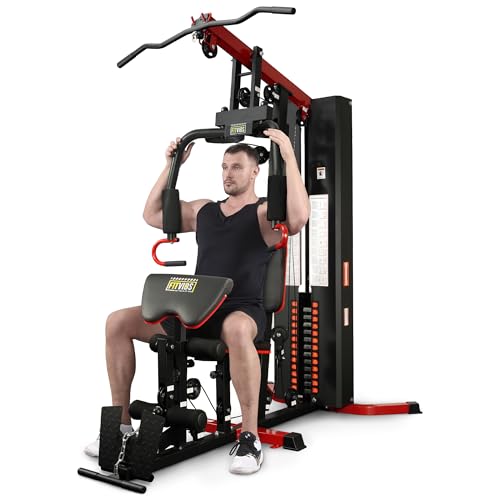
Fitvids takes the “compact but serious” approach, and the numbers jump out quickly: a 160 lb stack, 15 pulleys, and a higher claimed user capacity. That spec mix usually points to smoother cable travel and fewer awkward angles, which is exactly what you want when you’re chasing calorie burn through full-body training density. The included leg press option also helps round out lower-body work without adding a separate machine.
Pros
- 160 lb stack gives more runway
- 15 pulleys keep motion fluid
- Compact size fits tight rooms
- Higher user capacity adds confidence
- Supports many push-pull-leg combinations
- Good for circuit-style training
Cons
- Bigger footprint than ultra-compact options
- Still limited versus free-weight loading
In a real workout flow, this machine shines when you treat it like a circuit hub: pulldown to chest press to row to leg press, then quick accessory work for arms and core. The pulley count usually translates to less cable chatter and less “jerk” at the start of a rep, which helps you keep tension where it belongs. For weight loss, that smoother feel makes it easier to keep moving and keep form tight even as fatigue builds.
Choose this if you want a single station that supports consistent, progressive full-body strength training—the kind that helps maintain muscle while you cut. It’s a strong match for couples or families sharing one machine, thanks to the higher capacity and broader exercise range. Skip it if you need the feel and loading options of barbells, or if your space can’t handle the listed footprint.
Fitvids Multifunctional Home Gym Weight Stack Machine

This all-in-one home gym targets weight loss through consistent strength training and higher weekly training volume. The 122.5 lb stack supports progressive overload for beginners and intermediates, while high and low pulleys cover pulling, pressing, and core patterns without swapping machines. It suits small spaces and shared households where quick exercise transitions matter. Best results come from pairing full-body circuits with short rest periods and a calorie-controlled diet.
Pros
- Covers most major movement patterns with one footprint
- Pulley motion feels smoother than many budget cable systems
- Fast weight changes support circuit-style fat-loss training
- Weight stack is quieter than plate-loaded alternatives
- Compact size fits garages, apartments, and spare rooms
Cons
- 122.5 lb stack may cap stronger users
- Assembly can be time-consuming and space sensitive
In daily use, it works well for full-body sessions: lat pulldowns, rows, chest flyes, triceps pressdowns, and cable crunches. For weight loss, it shines when you run supersets and keep rest short, since you can move between stations quickly. Cable resistance feels consistent, helping maintain tempo. Expect better results with higher-rep sets and steady progression, rather than chasing maximal loads.
Buy this if you want a single machine for consistent strength training at home, especially if time and space are limited. It fits beginners to intermediates focused on fat loss through muscle retention and higher training frequency. If you already lift heavy or need very high resistance for legs and back, you may outgrow the stack. Value is strongest for households wanting variety without multiple machines.
AXV Vibration Plate Fitness Platform Machine

A vibration plate is a supplemental tool, not a primary fat-loss driver. It can increase muscle activation during holds, light squats, and mobility work, and may help people who struggle with traditional cardio start moving consistently. The wide speed range and included bands add some training variety, but calorie burn is modest compared with walking, cycling, or resistance circuits. Treat it as an adherence aid and recovery accessory.
Pros
- Easy to use for short daily movement sessions
- Can add challenge to squats, planks, and calf raises
- Bands allow light upper-body work during vibration
- Useful for warmups, mobility, and post-workout recovery
- Low impact option for deconditioned users
Cons
- Fat-loss results are limited without diet and training
- Vibration intensity can feel uncomfortable for some
Most people use it in short bouts: a few minutes of standing, light squats, or planks, then bands for rows and presses. It can make low-effort sessions feel more engaging, which helps consistency. Noise and vibration transfer depend on flooring; a mat often helps. For best outcomes, use it as a warmup or finisher alongside regular walking and strength training, not as the main workout.
Choose this if you need a low-impact, low-barrier tool to support daily activity, warmups, or light conditioning. It can be helpful for beginners, busy users, or anyone who benefits from structured micro-sessions. Skip it if you want a standalone weight-loss solution or prefer traditional cardio. Value is best when used consistently as an add-on to diet, steps, and resistance training.
Frequently Asked Questions
Which gym-style equipment burns the most calories for weight loss?
Multi-station cable machines support full-body circuits with minimal downtime. Pair push, pull, legs, and core in supersets to keep heart rate elevated while still progressing strength.
How much weight stack is enough for fat loss and toning?
For most users, 122.5 to 160 lb stacks cover progressive overload on rows, presses, pulldowns, and leg work. Fat loss comes from consistency, total weekly volume, and diet, not extreme stack size.
Is a vibration plate a good primary tool for weight loss?
It can boost daily movement and support warmups, mobility, and light conditioning. It is not a substitute for resistance training; treat it as an add-on, not your main fat-loss driver.
Verdict
Best overall: Fitvids Multifunctional Home Gym Equipment with 160 lbs Weight Stack for the strongest blend of resistance range, exercise variety, and circuit-friendly training. Best budget: Fitvids Multifunctional Home Gym Equipment with 122.5 lbs Weight Stack for solid full-body coverage at a lower cost. Sportsroyals and SincMill are good alternatives if you prefer their layouts. AXV Vibration Plate works best as a supplement for warmups and light conditioning, not a primary fat-loss setup.