
Ever show up somewhere and realize your product failed at the worst moment? The best door anchor for resistance bands keeps your band stable and your door safe. You get cleaner angles for rows, presses, and pulldowns. You also avoid strap slip that breaks your set rhythm. Specs like anchor count and load rating matter fast.
A door anchor turns any closed door into a training station. You can change angles without moving heavy gear. The best setups control height, protect the door edge, and clip fast. Strap systems add multiple positions for full-body work. Hook systems add rigid steel support. Your door gap and trim style decide what works best.
| Product | Key Features | Action |
|---|---|---|
|
See Current Price | |
|
See Current Price | |
|
See Current Price | |
|
See Current Price | |
|
See Current Price |
Brebebe Door Anchor Strap 5-Point

Your best door anchor for resistance bands choice often depends on height options. This strap gives 5 anchor positions from top to bottom. You also get 5 stainless steel D-rings for easy clipping. The maker lists 500 lb strength for the rope. Setup stays tool-free and punch-free. The strap length shows 5.2m for routing and reach.
Specification data indicates a long strap spreads load across the door edge. The stainless steel D-rings should resist rust better than painted rings. Five points help you keep band line straight. That matters for flys and rows. The listed 500 lb rating sounds strong. Your door and hinges still limit real load.
Pros
- 5 anchor points for height control
- 5 stainless steel D-rings for clips
- Tool-free, nail-free setup
- Listed 5.2m strap length
- Listed strength up to 500 lb
Cons
- Door height limit: 2.6m max
- Material details beyond rings not specified
Why you might look elsewhere: If you need a hard steel hook for suspension straps, skip this. A strap edge can still pinch soft trim. If your doors exceed 2.6m, the listed fit may fail. People who only want one fixed height may find five points unnecessary.
Based on the listed 5.2m length, you can route it over tall doors. You clip bands to the D-rings at different heights. That helps with chest presses, triceps work, and leg moves. The punch-free setup suits rentals. You still need a door that closes tight. A loose latch can shift under tension.
My Take: Worry about stability and height range makes sense here. The five anchor points and steel D-rings cover most band angles. Stay within the door height limit and use a solid door. If you want a multi-height strap system, you should pick this one.
Adjustable Door Anchor Strap With Cam Buckle

Adjustable straps fix a common door issue fast. This model uses 5 loops plus 5 metal D-rings. You get many clip points for full-body moves. A cam buckle locks the strap at a chosen height. The listing also calls out reinforced stitching. It folds flat for travel. That helps when you train away from home.
The cam buckle is the key spec here. It should reduce mid-set strap creep. Five loops and rings give flexible attachment. That supports latex loop bands or carabiner-style bands. The listing claims double stitching and thick nylon. Specs do not list a load rating. You must match tension to your door strength.
Pros
- Cam buckle locks chosen height
- 5 loops and 5 D-rings
- Reinforced stitching listed
- Tool-free setup on doors
- Folds flat for travel
Cons
- No load rating listed
- Door size limits not specified
Why you might look elsewhere: If you need a stated strength number for rehab rules, look elsewhere. Some programs require a rated limit. If you train on extra-thick doors, the buckle range may not fit. People who hate buckles may prefer fixed loop straps.
According to the description, you drape it over the door. You then close the door and set height. The cam buckle should let fine height changes. Five clip points help you keep angles consistent. Metal rings should handle carabiners better than fabric loops alone. You still need a door that shuts fully.
My Take: The main hesitation is the missing load rating. The buckle lock and multi-point layout still solve most setup pain. Keep tension reasonable and use a solid, closed door. If adjustability matters most, you should choose this strap.
Kipika Heavy Duty Steel Door Hook Anchor

Rigid door hooks feel different than soft strap anchors. This one uses steel with a one-piece build. The maker calls out a premium welding process. You also get plastic protection pads on both ends. A locking nut helps stop the band from slipping off. It clamps on the door with hand tightening. The listing states 500 lb capacity.
A steel hook can hold alignment under heavy pulls. The protection pads matter for painted doors. The lock nut adds a mechanical stop for band loops. That can reduce pop-off risk. Fit depends on door thickness and frame gap. The listing says it adjusts to common thicknesses. You must check clearance before you tighten it down.
Pros
- Steel body with one-piece build
- Plastic pads help protect doors
- Locking nut helps prevent band drop
- Hand-tight install, no drilling
- Listed capacity up to 500 lb
Cons
- Needs door-frame gap clearance
- Anchor points: single fixed height
Why you might look elsewhere: If you want many height options without moving hardware, skip this. You must reposition the hook for height changes. If your frame gap stays very tight, clamping may not work. If you train on hollow, weak doors, a steel hook can stress them.
Based on the clamp install, you mount it on the door edge. You then tighten by hand to lock position. The steel structure should keep shape under tension. The pads should spread contact and reduce marks. The single hook suits rows, presses, and pulldowns. You must move it for low anchors and high anchors.
My Take: You might worry about door damage or band slip. The pads and locking nut address both worries well. Confirm your door gap and use a sturdy door. If you want a rigid, clamp-on anchor with a stated rating, you should get this one.
Heavy Duty Nylon Door Anchor Attachment
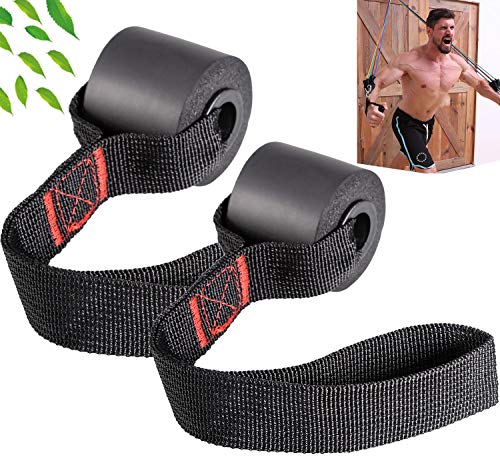
Strong anchoring matters when bands pull hard. This door anchor uses thick nylon webbing and heavy duty stitching. The dense foam stopper aims to protect your door. You get a simple setup for home workouts. It fits most exercise bands by design. Use it for pushes, pulls, and rotations. It targets anyone building a compact door-gym. It also suits travel bags and small spaces.
Thick webbing helps reduce stretch under load. Heavy stitching should resist seam creep over time. The foam block spreads pressure on the door edge. That can reduce dents and paint marks. The anchor loop should accept tube and flat bands. Band contact points matter for fray risk. The listing claims no fraying after weeks. That suggests smooth edges on the loop.
Pros
- Thick nylon webbing for stronger anchoring
- Heavy duty stitching for tear resistance
- Dense foam stopper helps protect doors
- Works with most resistance band types
- Lightweight and easy to pack
Cons
- No stated load rating or tested capacity
- Single anchor point limits height options
Why you might look elsewhere: If you need multiple height anchors, look elsewhere. This design gives one fixed point per setup. If you train with very heavy band tension, avoid unknown ratings. Choose a system with a published load limit.
You set the foam end behind a closed door. You run the band through the loop. You can switch sides for pulls or presses. The foam should reduce door edge wear. The webbing should stay stable during reps. You still need a solid door and latch. Hollow doors can flex under tension. Keep the band centered to cut rubbing.
My Take: You may worry about door damage and strap tearing. The foam stopper and heavy stitching address that risk. If you want a simple pick for the best door anchor for resistance bands, this one makes sense. Choose it for basic, single-position door training.
Multi-Point Door Anchor Strap With Ratchet

Versatility helps when you train different angles. This strap uses 7 loops and 7 D-rings. You can set anchor height without moving the strap. The ratchet adjuster aims to keep tension tight. It installs without tools or drilling. The listed strap length is 5.2 m. It supports doors up to 2.4 m tall. The brand claims a 500 lbs capacity.
Multi-point anchors expand exercise selection. You can run bands from high, mid, or low points. The ratchet should reduce strap slip during hard pulls. D-rings can handle carabiners and handles. The stated 500 lbs rating suggests strong webbing. Door height limits matter for fit. The long strap can wrap and tighten well. Hardware quality still drives long-term durability.
Pros
- 7 anchor points for many exercise angles
- Ratchet tighten helps stop strap loosening
- Claims 500 lbs load capacity
- 5.2 m strap fits many door setups
- No tools or drilling needed
Cons
- Fits doors up to 2.4 m only
- More parts add setup complexity
Why you might look elsewhere: If your door is taller than 2.4 m, skip it. The strap may not tighten correctly. If you hate fiddly setups, avoid ratchets and rings. A single-loop anchor feels faster. If you need wall mounts, this won’t replace them.
You loop the strap over the door and close it. You tighten the ratchet to remove slack. You pick one of 7 heights for each move. That helps lat pulls, rows, and presses. D-rings allow quick clip changes. The long strap can suit wide door frames. Check door swing direction before loading. Keep the ratchet away from the door edge.
My Take: You may worry about slipping during strong pulls. The ratchet tighten design targets that issue. For the best door anchor for resistance bands with height options, this is a strong spec match. Choose it when you want one strap for many angles.
Quick Answers
Will a door anchor damage your door or frame?
Pick a padded stopper and keep the strap flat. Close the door toward the pull direction. Avoid sharp edges and weak trim. If your frame is soft wood or loose, use a wall mount instead.
Which side of the door should you anchor on?
Anchor on the hinge side when possible. Close the door so it resists your pull. Pulling against the latch side can flex the door more. Never anchor on a door that can open toward you.
Do multi-loop anchors work with tubes, bands, and handles?
Yes, if the loops fit your carabiners or clips. Metal rings help with smooth clipping. Thick tube clips may need larger rings. For bare bands, avoid rough stitching that can rub latex.
A door setup you can trust
You want the best door anchor for resistance bands without door worries. Best Overall goes to Brebebe Upgrade with ratchet tightening and 7 loops + 7 D-rings. It stays put and adds clean height options. Best Budget is Kipika Heavy Duty. It holds steady, pads the door, and keeps setup simple. If you need commercial loads or constant group use, skip door anchors. If your door is hollow or loose, use a wall mount. Choose Brebebe Upgrade for versatility, or Kipika for solid basics.