
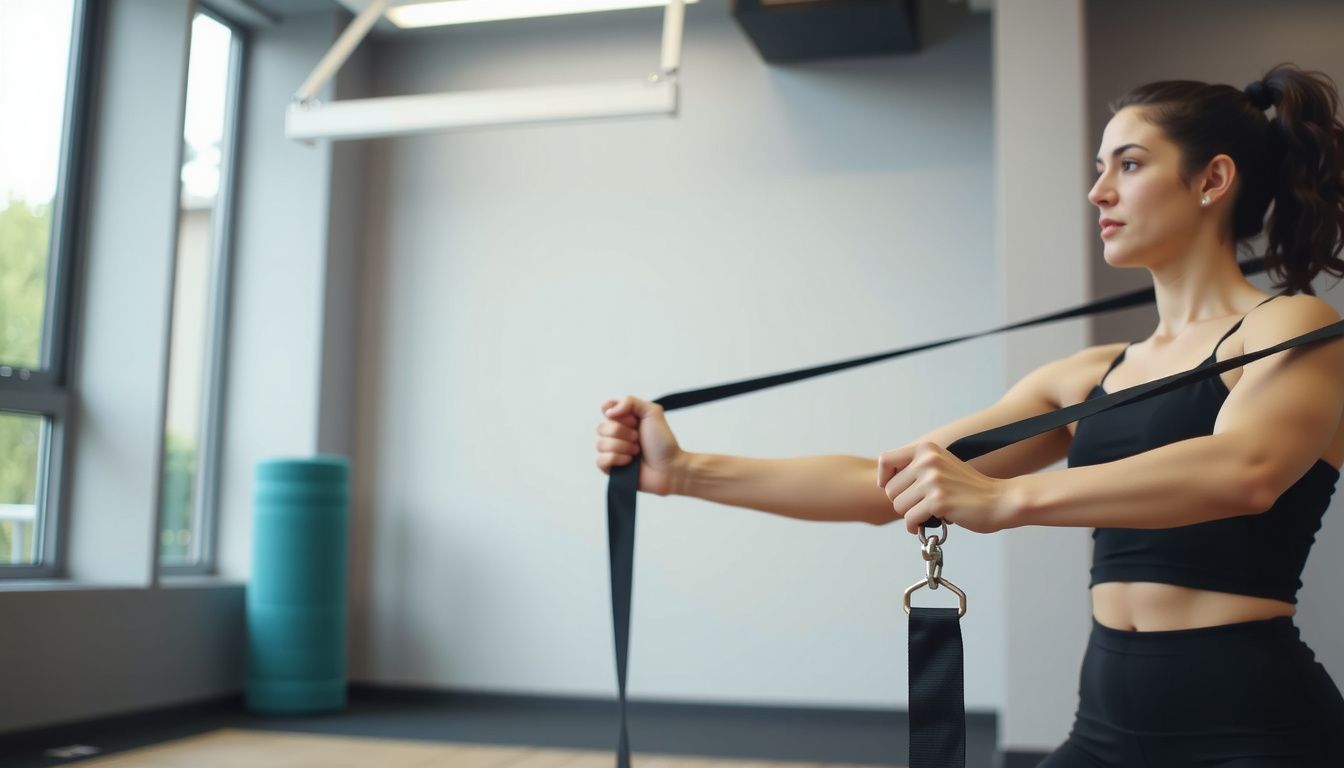
what does resistance bands help with when you’re short on time, space, or equipment? A lot more than most people expect—strength, mobility, and even joint-friendly training—using a tool that fits in your backpack.
Resistance bands create constant tension through a full range of motion, so your muscles stay “on” from start to finish. That makes them useful whether you’re brand new to exercise or you’re rebuilding after time off.
From coaching beginners to programming home workouts, you’ll see bands work best when you want simple progress without heavy weights. They’re also easy to scale: change the band, shorten your grip, or adjust your stance.
In this guide, you’ll learn how bands support:
- Muscle strength and endurance (upper body, lower body, and core)
- Mobility and warm-ups (hips, shoulders, ankles)
- Rehab-style control for tendons and joints
- Glute activation and posture-focused work
Real-life example: keep a loop band by your desk and do 2 sets of 15 lateral steps on a break—you’ll light up your glutes and feel your hips “wake up” before your next meeting. Ready to pick the right band and start using it safely?
What Resistance Bands Are and Why They Work for You
Now that you’ve seen how flexible band training can be, it helps to know what you’re actually using. Resistance bands are elastic tools that create tension as you stretch them, so your muscles work harder through the movement. That tension scales naturally: the farther you pull, the more resistance you feel.
They work well because they keep your muscles “on” for more of each rep. With many dumbbell moves, there’s a point where leverage makes the lift easier. Bands often do the opposite, increasing challenge near the end range where you tend to lose control.
- Variable resistance matches your strength curve and increases effort where you’re strongest.
- Joint-friendly loading can reduce impact while still training hard.
- Constant tension improves control, tempo, and muscle connection.
Practical example: loop a band under your feet and press overhead. You’ll feel a smooth ramp-up in tension at the top, prompting better bracing and steadier shoulders.
What Does Resistance Bands Help With for Strength and Muscle Tone?
Look, what does resistance bands help with when your goal is strength and a more “toned” look? You can build strength by progressively increasing band tension, using thicker bands, shortening slack, or adding reps and slower tempos. Muscle tone comes from muscle development plus lower body fat, and bands support the muscle-building side effectively.
Bands shine for targeting specific muscles with clean form. They also let you train the same pattern in multiple ways, which helps you keep progressing without beating up your joints.
- Upper body: rows, presses, face pulls for back, chest, and shoulders.
- Lower body: squats, deadlifts, lateral walks for glutes and legs.
- Core: Pallof presses, anti-rotation holds for stability.
Practical example: do 3 rounds of 10 banded rows, 12 banded squats, and a 20-second Pallof hold per side, resting 45 seconds. Track band thickness and total reps weekly to ensure progress.
How Resistance Bands Help You Improve Mobility and Flexibility
Now let’s shift from building strength to moving better. Resistance bands give you low-impact tension through a controlled range, which helps you practice smooth, repeatable motion without “cheating” with momentum.

You can use bands to increase mobility (joint range under control) and improve flexibility (tissue length tolerance). The key is gentle load plus time under tension, so your nervous system feels safe letting you move farther.
- Shoulder: band dislocates or external rotation to open tight front delts
- Hips: banded hip flexor mobilizations to reduce stiffness after sitting
- Ankles: banded dorsiflexion mobilizations to help deeper squats
Practical example: before a workout, loop a light band around a rack and your ankle, then do 2 sets of 10 slow knee-over-toe reps per side. You’ll often feel immediate improvement in squat depth and smoother steps on stairs.
How Bands Support Your Joints, Tendons, and Injury Recovery
Look, joints usually don’t need “more force.” They need better force. Bands let you scale resistance in tiny steps, making them ideal when you’re rebuilding tolerance after pain, surgery, or overuse.
Because tension rises gradually, you can keep movements in a comfortable zone while still training the tissues that stabilize you. This is especially useful for tendons, which respond well to consistent, progressive loading.
- Isometrics: hold a banded squat or row 20–45 seconds to reduce flare-ups
- Tempo reps: 3-second lowers for controlled tendon loading
- Joint-friendly angles: adjust band position to avoid painful ranges
Practical example: for cranky elbows, do banded wrist extensions—2–3 sets of 12–15 slow reps, 3–4 days/week. Keep discomfort mild (about 2–3/10), then progress band tension only when next-day soreness stays manageable.
How Resistance Bands Help You Activate Muscles and Fix Imbalances
Now that your joints move better, bands can help you “find” the right muscles again. The constant tension forces your body to stay honest, so weak links show up fast.
You’ll get better muscle activation because bands demand control through the whole range. That’s useful when one side dominates, or when stabilizers switch off during big lifts.
Band work is especially effective for:
- Glute activation (reducing knee collapse and low-back overwork)
- Scapular control (improving shoulder mechanics)
- Core anti-rotation (evening out left-right strength)
Practical example: before squats, loop a mini band above your knees and do 2 sets of 12 lateral steps each way. Then perform 8 slow bodyweight squats, pressing your knees gently out. You’ll feel your glutes switch on, which often cleans up hip shift and knee valgus.
Keep the resistance light enough that you can move smoothly. If you’re shaking, you’re compensating, not correcting.
How Bands Help You Build Endurance and Burn Calories
Look, bands aren’t just for strength—they’re great for work capacity. Because setup is quick, you can stack exercises with minimal rest and keep your heart rate up.
You build muscular endurance by staying under tension for longer sets. You also burn more calories when you use large muscle groups and move continuously, even with moderate resistance.

Use bands to create simple conditioning blocks like:
- Timed sets (30–45 seconds of work, 15 seconds rest)
- High-rep sets (15–25 reps with strict form)
- Circuits (3–5 moves repeated for 3 rounds)
Practical example: 3 rounds—band thrusters x15, band rows x20, band deadlifts x20, then a 45-second band Pallof press hold per side. Rest 60 seconds between rounds. You’ll feel a full-body burn without pounding your joints.
Stay crisp on technique; sloppy reps turn conditioning into strain.
How to Choose the Right Resistance Band for Your Goals
Now that you’ve got the “why,” you need the right tool for the job. Band choice affects tension, comfort, and how smoothly you can progress. Pick well, and your workouts feel challenging without wrecking your form.
Start by matching band type to your main goal and setup. Loop bands excel for lower-body work and assisted pull-ups, while tube bands with handles feel natural for presses and rows. Mini bands are best for glute activation and hip stability drills.
- Strength focus: thicker loop or heavy tube band; aim for 6–12 hard reps
- Mobility/rehab: light band; prioritize control and pain-free range
- Home full-body training: a set of 3–5 resistances for progression
Practical example: if you can do 15 band rows easily with perfect posture, move up one level so 10–12 reps feel tough while your shoulders stay down and back.
How to Use Resistance Bands Safely: Form, Progression, and Common Mistakes
Look, bands feel “easy” until they don’t. Because tension increases as the band stretches, small form errors get amplified at the hardest point. Your goal is clean reps, steady control, and predictable progression.
Use a simple safety checklist before each set. Inspect for cracks, anchor securely, and keep your wrists and spine neutral. Control the return phase; snapping back is where strains and band failures happen.
- Form: brace your ribs down, move through the target joint, avoid shrugging
- Progression: add reps first, then tension, then range of motion
- Tempo: 2 seconds up, 2–3 seconds down for most moves
Practical example: for a band chest press, step forward to create tension, press without locking your elbows, then step back slightly if your shoulders roll forward.
Common mistakes: letting the band go slack mid-rep, twisting the band, and choosing resistance so heavy you can’t finish the last 2 reps with the same technique.
Final Summary
Now that you’ve seen the full picture, you can answer what does resistance bands help with in one phrase: consistent, low-barrier progress. Bands make it easier to train anywhere, stay on track when time is tight, and keep your workouts repeatable without complicated setups.
Your best results come from using bands with intent. Focus on:
- Consistency over intensity spikes
- Simple tracking (band level, reps, sets, tempo)
- Balanced weekly coverage (push, pull, hinge, squat, carry)
Real-world example: if you travel for work, you can keep a mini band in your bag and run a 12-minute hotel-room circuit (rows, presses, squats) so you don’t lose momentum between gym sessions.
Next step: pick one goal for the next 14 days, schedule three band sessions, and log every workout so you can progress with confidence.