
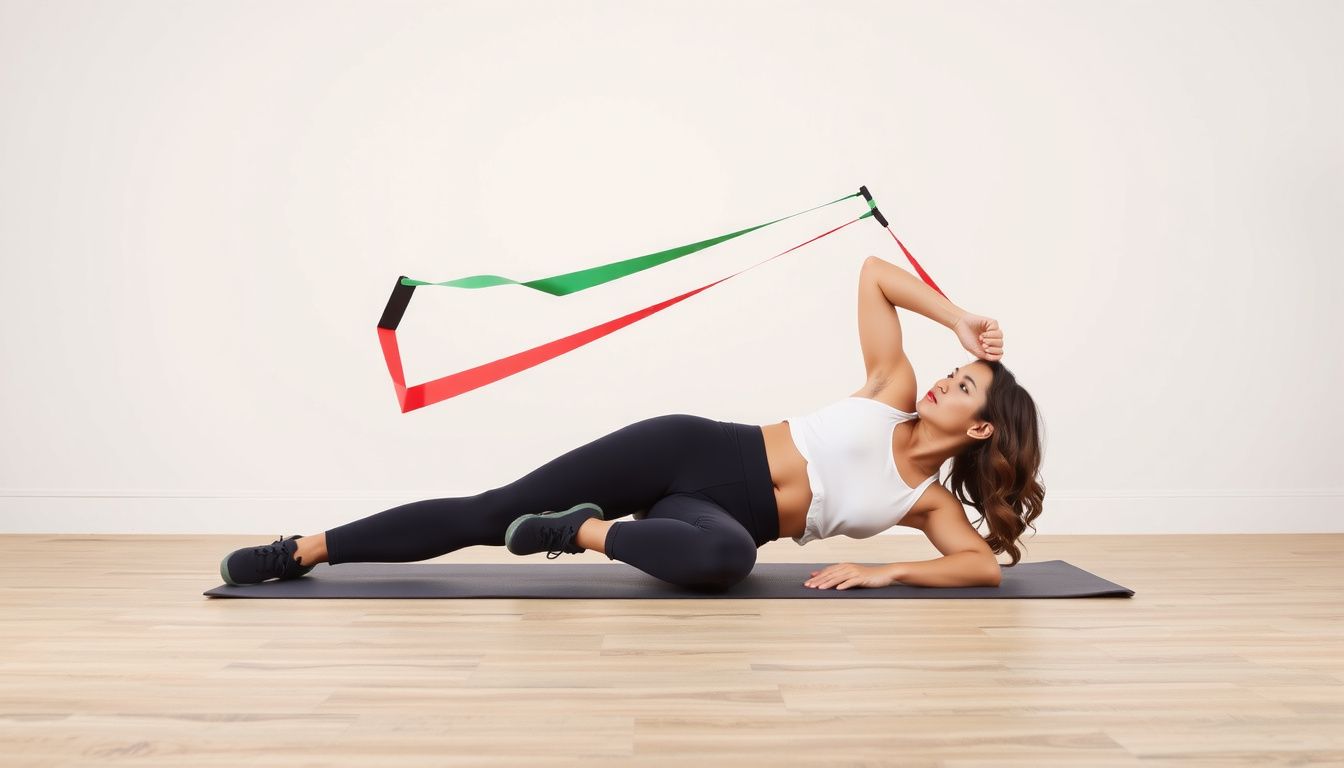
How to do exercise with resistance bands can be the difference between skipping a workout and getting one done when your day gets busy. You’re at home, it’s raining, the gym feels like a project, and you still want to move your body without wrecking your joints.
Look, bands are simple, but they’re not “automatic.” Tension changes through the range of motion, and small setup details (anchor height, stance, grip) decide whether you feel your glutes and back—or your neck and lower back. This guide walks you through safe form, smart exercise selection, and how to progress without guessing.
Here’s a practical example: you loop a band under your feet for a row, but you round your shoulders and shrug. A quick fix—hinge at your hips, brace your core, and pull your elbows toward your pockets—turns it into a clean back-builder in seconds.
You’ll learn how to:
- Choose the right band for strength, mobility, or rehab
- Set up anchors and body position for consistent tension
- Use tempo, reps, and range of motion to progress safely
- Avoid common mistakes that cause pain or stalled results
Get Ready: Choose Your Bands, Space, and Goals
Now that you’re committed, set yourself up so the workout feels automatic, not complicated. Your first job is picking the right resistance and removing friction from your environment.
Start with band type and tension. If you’re new, choose a light and a medium band so you can adjust without guessing. Match resistance to the weakest point of the movement, not the strongest.
- Loop bands for squats, glute work, lateral walks, and assisted pull-ups
- Tubing with handles for rows, presses, curls, and triceps work
- Mini bands for activation (hips, shoulders) and rehab-style control
Next, check your space. You need a non-slip floor, one sturdy anchor point (door anchor or post), and enough clearance to extend your arms fully. Keep a towel nearby; sweaty hands change grip and tension fast.
Set one clear goal for today: strength (8–12 controlled reps), endurance (15–25 reps), or mobility/rehab (slow, pain-free range). Example: if you travel for work, pack a medium loop band and do 3 rounds of squats, rows (anchored in a hotel door), and overhead presses in 15 minutes.
Warm Up Your Joints and Activate Key Muscles
Look, bands reward preparation. A fast warm-up improves range of motion, reduces “snapping” tension, and helps you feel the right muscles working.
Spend 5–8 minutes moving joints first, then activating muscles you’ll rely on. Keep resistance light; you’re priming coordination, not chasing fatigue.
- Joint prep (2–3 minutes): neck turns, shoulder circles, hip circles, ankle rolls
- Spine and hips (1–2 minutes): cat-cow, bodyweight hinges, deep squat holds
- Activation (2–3 minutes): band pull-aparts, glute bridges with a mini band, dead bugs
Pro tip: move slowly on the return (eccentric). That’s where bands often pull you out of position, especially on rows and presses.
Common mistake: starting with a heavy band and “muscling through” shaky reps. If your shoulders shrug up or your lower back arches, reduce tension or shorten the range until you can control it.

Practical example: before banded rows, do 15 pull-aparts and 10 scapular retractions. Your upper back will engage sooner, and your biceps won’t take over.
Set Up Correctly: Anchor, Grip, and Body Position
Now that you’re warm and ready to move, your setup decides whether bands feel smooth or sketchy. Treat the band like a cable machine: stable anchor, clean line of pull, and controlled tension.
Start with your anchor. If you’re using a door anchor, close and lock the door, then pull-test it hard before you train. If you’re stepping on the band, center your foot and keep it flat so the band doesn’t roll.
- Anchor height: match it to the movement (chest for presses/rows, low for hinges, high for pulldowns).
- Line of pull: the band should track straight; avoid rubbing across your body or twisting.
- Pre-tension: start with light tension so you’re not “dead” at the first rep.
Your grip matters. Hold the band like a handle—wrist straight, knuckles stacked—so tension loads the target muscle, not your forearm. If the band bites, loop it once around your palm, but don’t wrap it so tight you can’t release.
Set your body position next: ribs down, pelvis level, and feet planted. Common mistakes: standing too close (no tension), leaning back to “cheat,” or letting the band snap back.
Practical example: for a door-anchored row, anchor at navel height, step back until the band is lightly stretched, hinge slightly, then row with elbows tracking 30–45° from your torso.
Master Core Moves With Perfect Form (Push, Pull, Squat, Hinge)
Look, you don’t need 30 exercises. Nail four patterns—push, pull, squat, hinge—and you can train your whole body with bands while keeping joints happy.
For pushes (band chest press or overhead press), keep your forearms vertical at the hardest point and don’t flare your ribs. Pro tip: exhale as you press to lock your trunk and stop low-back arching.
For pulls (rows, pulldowns, face pulls), lead with your elbows and finish with your shoulder blades, not your biceps. Common mistake: shrugging up; think “shoulders down and back” as tension increases.
- Squat: sit between your heels, knees track over toes, band stays evenly loaded under both feet.
- Hinge: push hips back, shins mostly vertical, spine neutral, feel hamstrings stretch.
- Tempo: control the return for 2–3 seconds; don’t let the band yank you.
Use range that you can own. If form breaks at the top where bands peak, shorten the range or use a lighter band.
Practical example: for a band deadlift hinge, stand on the band, grab both ends, brace, then drive hips forward to stand tall—stop before your lower back takes over.
Build Your Workout: Sets, Reps, Tempo, and Progressions
Now that your form is dialed in, you need structure so each session feels repeatable and measurable. That’s where sets, reps, tempo, and progression come in.

Start with 4–6 moves and cover the basics: push, pull, squat/hinge, and core. For most goals, aim for 2–4 sets per exercise and stop with 1–3 reps “in the tank” so technique stays clean.
- Strength: 6–10 reps, slower tempo, longer rest (60–120s)
- Muscle/toning: 10–15 reps, controlled tempo, moderate rest (45–75s)
- Endurance: 15–25 reps, steady tempo, short rest (20–45s)
Use tempo to make lighter bands challenging. Try a 3-1-1: lower for 3 seconds, pause 1, lift 1. Common mistake: rushing the return; you lose tension and joint control.
Practical example: Full-body circuit—band row 3×12 (3-1-1), band squat 3×15, band overhead press 3×10, band deadlift 3×12, Pallof press 3×10/side. Rest 60 seconds between rounds.
Progress weekly by changing only one variable: add 2 reps, add a set, slow tempo, shorten rest, or move to a thicker band. Pro tip: if you can exceed the top rep range with perfect form, it’s time to progress.
Recover and Stay Consistent: Cooldown, Mobility, and Next Steps
Look, the workout isn’t finished when the last rep ends. A short cooldown helps you recover faster and makes tomorrow’s session more realistic.
Spend 5–8 minutes bringing your heart rate down, then open up the areas you just trained. Keep it simple and repeatable so you’ll actually do it.
- Downshift: 2 minutes easy marching or nasal breathing
- Mobility: 30–45 seconds each for hips, T-spine, shoulders
- Light band work: face pulls, pull-aparts, or shoulder external rotations
Common mistake: aggressive stretching when you’re already fatigued. You want gentle range, not pain. Pro tip: prioritize the joints that limit your form—tight hips often wreck squats, stiff shoulders often ruin presses.
Practical example: After a band lower-body day, do a couch stretch (45s/side), 90/90 hip switches (10 reps), then banded glute bridge holds (2x20s) to “reset” your hips.
Next steps: schedule 2–4 sessions per week, log band color and reps, and plan one progression each week. If soreness lingers past 48 hours, reduce volume first (fewer sets), not intensity.
Your Action Plan
Now you’re ready to put how to do exercise with resistance bands into practice without overthinking it. Keep your plan simple, repeatable, and easy to track so you can see progress week to week. Small, consistent sessions beat occasional “perfect” workouts.
Use this quick checklist before you start each session:
- Pick one focus (full-body, upper, lower, or core) and stick to it.
- Choose 4–6 moves you can perform confidently and pain-free.
- Log one metric (band color, reps, or time-under-tension) so you can progress.
- Stop with 1–2 reps in reserve to protect form and joints.
Real-world example: if you train after work, keep a loop band in your backpack and run a 15-minute circuit before dinner—same day, same time, no negotiation. Your next step: schedule your next three band sessions on your calendar right now and commit to showing up.
Related read: How Does Resistance Bands Work for Building Strength