

Most home gyms fail for one boring reason: the basics don’t match the space. A giant machine that blocks a doorway, a bench that wobbles mid-set, or flooring that dents under dumbbells can turn motivation into frustration fast. The right equipment makes training feel simple, safe, and repeatable.
Persona: The Garage-Gym Realist. Home gym equipment matters because it decides what you’ll actually do when nobody’s watching. A smart setup gives you safe strength work, smooth cable training, and a floor that doesn’t punish your joints or your house. The trick is balancing versatility with footprint: racks and functional trainers unlock progression, while benches and mats quietly determine comfort, noise, and long-term durability. We focused on gear that covers real movements, not gimmicks.
How we picked gear we’d keep bolted down
We evaluated each item like it was going into a normal home: limited space, shared floors, and quick workouts between errands. As a team, we checked frame thickness and stability cues, looked at pulley counts and cable travel for smoothness, mapped exercise coverage (push, pull, squat/hinge, arms, legs), and judged setup practicality—attachments included, adjustability, and how fussy the system is day to day. We also weighed noise and floor impact, since that’s what gets home gyms abandoned.
Mikolo K6 Power Cage with Cable Crossover Package

A full cage plus cables is the kind of “buy once, build around it” move that can replace a whole corner of commercial gym access. The Mikolo K6 kit arrives as a loaded package—power cage, cable crossover, bench, Olympic barbell, and a 230 lb rubber weight set. First impression: it’s aimed at serious home lifters who want in-cage safety and cable variety without spending weeks hunting compatible add-ons.
Pros
- True cage setup feels safer for beginners
- Cable crossover adds real exercise variety
- Upgraded rollers should reduce pulley sticking
- Kit includes bench, bar, plates
- Band pegs and landmine expand training
- Dip and chin stations save space
Cons
- Large footprint needs dedicated area
- Assembly and organization take patience
In daily use, the “true cage” layout matters: you can set safeties, work inside the frame, and feel less exposed on squats or presses. The cable crossover and lat/low-row options cover a lot of accessory work—face pulls, triceps, rows—without dragging dumbbells around. Those sliding sleeves with multiple rollers suggest smoother pulls and less jerky resistance, especially under moderate loads. With plates, bar, and bench included, it’s a one-delivery starter gym.
Buy this if you want a single anchor piece that handles barbell training plus cable work, and you’ve got a garage or spare room where it can live permanently. It makes sense for households with multiple lifters because you can bounce between rack work and cables quickly. Skip it if you need something you can move, fold, or tuck away; the value here depends on committing space and time to assembly.
Mikolo Home Gym Station with 150 lb Stack

Not everyone wants plates scattered across the floor, and that’s where a selectorized stack machine earns its keep. Mikolo’s 150 lb stack home gym leans into convenience: one frame covers PEC fly, lat pulldown, low row, chest press, leg extension, leg press, preacher curl, and more. The vibe is “walk up and train” rather than “load plates, adjust safeties, then start,” which is a real win for consistency.
Pros
- Selectorized stack makes quick weight changes
- Covers push, pull, arms, legs
- 14-gauge steel frame feels confidence-building
- Multiple pulley heights improve exercise angles
- Preacher pad and leg press included
- Bearing on bar eases wrists
Cons
- 150 lb stack may cap stronger lifters
- Big station limits room layout options
Because the weight stack is built in, supersets feel realistic at home—pin change, keep moving, no plate math. The high/mid/low pulleys open up practical movements like lat pulldowns, cable curls, triceps pressdowns, and seated rows without awkward cable angles. The leg press and leg extension give lower-body work that many home setups miss, though range and comfort will depend on your height and how the pads line up. Noise should be fairly contained compared to plate loading.
This suits families, beginners, and “busy schedule” lifters who benefit from fast setup and guided movement patterns. It’s also a good choice if you don’t trust your form under a barbell yet but still want full-body strength training at home. Avoid it if your main goal is heavy powerlifting progression; a 150 lb stack can feel limiting once your pulls and presses get strong.
Marcy MWM-988 Multifunction Steel Home Gym

Marcy’s MWM-988 is the old-school workhorse style of home gym: steel frame, selectorized 150 lb stack, and the classic stations most people recognize immediately. What stands out is how straightforward it is—dual action press arms for chest press and butterfly work, a removable preacher curl pad, and combined arm/leg training in one footprint. It’s not flashy, but it’s the type of machine many garages quietly rely on for years.
Pros
- Steel tubing and guard rods feel sturdy
- 150 lb stack avoids plate swapping
- Press arms cover chest press and flys
- Preacher curl pad helps isolate biceps
- Upholstery reduces pressure on joints
Cons
- Movement paths can feel restrictive
- 150 lb stack may feel light later
For real training, this kind of machine shines when you want repeatable reps without overthinking technique. The guided press arms help keep shoulders in a consistent groove, which can be kinder on cranky joints than free weights. The removable curl pad is handy: keep it on for arm-focused days, pull it off when you want the front area clear. The weight stack lock and guard rods suggest safer, quieter lifting with less clank and fewer pinch points than plate-loaded setups.
Good match for beginners, rehab-style strength work, and anyone who values simple, safe movement patterns over endless exercise variety. It’s also practical for shared homes where multiple people train and nobody wants to re-rack plates. Pass if you’re picky about “free” natural movement or you’re already strong enough that a 150 lb stack won’t challenge your back and legs for long.
Fitvids Home Gym 160 lb Stack with Pulley and Leg Press
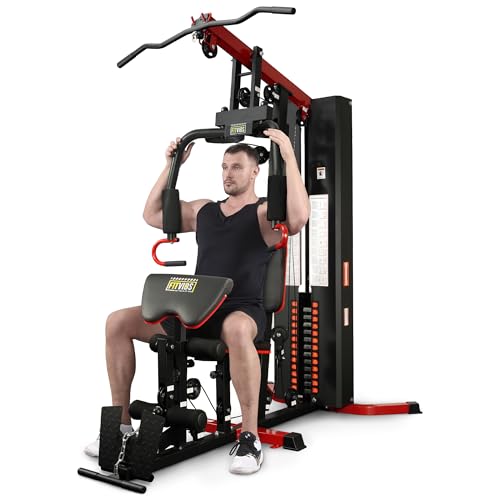
This all-in-one selectorized station suits small home gyms needing many movements in one footprint. The high and low pulley layout supports back work, arms, core, and accessory lifts, while the leg press adds lower-body volume without a separate machine. A 160 lb stack fits beginners through intermediates and lighter hypertrophy work. Best used as a primary machine when barbell space, noise, or equipment count is limited.
Pros
- Many exercises from one compact station
- Smooth pulley travel for rows and pulldowns
- Leg press option adds lower-body variety
- Selectorized stack makes quick weight changes
- Good choice for apartments and shared spaces
Cons
- 160 lb stack may cap strong lifters
- Assembly and tuning can take time
In daily training, it works best for consistent full-body circuits: pulldowns, seated rows, presses, curls, and triceps work flow quickly with pin changes. The pulley feel is generally smooth when cables are routed correctly and bolts are tightened evenly. The leg press is useful for higher-rep sets rather than maximal strength. Plan on periodic checks for cable tension and pulley alignment to keep motion quiet.
Buy this if you want one machine to cover most strength basics with minimal clutter. It is a practical value for beginners, intermediates, and households sharing equipment, especially where noise control matters. If your goals are heavy progressive overload on squats, deadlifts, or very heavy rows, you will likely outgrow the stack and want free weights or a plate-loaded system.
Fitvids Home Gym 122.5 lb Stack with Pulley and Leg Press

This version targets budget-minded home gyms that still want a full cable station plus leg press in a compact frame. The movement menu is similar to larger-stack models, making it a good foundation for general strength, rehab-friendly training, and higher-rep hypertrophy. The lighter 122.5 lb stack shifts the focus toward controlled tempo and volume. It fits well where space, simplicity, and quick exercise changes matter more than max loading.
Pros
- Compact all-in-one for balanced full-body training
- Quick pin changes support efficient supersets
- High and low pulleys cover most cable staples
- Leg press adds knee-friendly volume work
- Works well for beginners and lighter lifters
Cons
- 122.5 lb stack limits advanced pulling strength
- May need occasional cable tension adjustments
For day-to-day use, it shines in repeatable routines: lat pulldown to row, then press and arm work without moving equipment. The lower stack encourages clean form, pauses, and slow eccentrics, which can be effective for muscle gain. The leg press is best treated as an accessory movement for moderate reps. Expect to recheck fasteners after early sessions and keep pulleys clean for consistent glide.
Choose this if you are starting strength training, returning from a break, or prioritizing joint-friendly cable work at home. It offers strong utility per square foot for apartments and garages. If you already pull heavy on rows and pulldowns, or want long-term load headroom, the lighter stack may feel restrictive and a heavier stack or plate-loaded setup will be a better investment.
Yoleo Adjustable Foldable Weight Bench for Home Training

A foldable adjustable bench is a core home-gym piece because it multiplies what dumbbells, bands, and racks can do. This bench focuses on versatility with multiple back, seat, and leg positions, letting you train flat press, incline press, seated shoulder work, rows, and core variations. Its compact fold makes it practical for small spaces and shared rooms. It is best paired with adjustable dumbbells or a basic rack for progressive overload.
Pros
- Multiple angles for presses, rows, and core work
- Folds down for easy storage in small spaces
- Lightweight enough to move between rooms
- Fast adjustment supports efficient workouts
- Comfortable padding for moderate training volume
Cons
- Not ideal for very heavy barbell benching
- Narrower bench feel for larger lifters
In regular use, quick angle changes make it easy to run push-pull supersets and switch from incline pressing to chest-supported rows. The bench is stable for dumbbell work when placed on a flat, grippy surface. Folding is useful for keeping a living area clear, but unfolding and leveling it each session matters for confidence under load. Wipe-down cleaning keeps the padding from getting slick during longer sessions.
Buy this if you want a space-efficient bench for dumbbells, bands, and general strength training. It is a strong value when your goal is consistent full-body workouts rather than maximal barbell numbers. Lifters who plan to bench very heavy, use a rack frequently, or prefer a wider competition-style pad should consider a heavier, wider bench with higher load confidence.
ProsourceFit EVA Interlocking Foam Gym Floor Tiles

These interlocking EVA tiles are an entry-level flooring option for protecting surfaces and reducing noise in a home gym. They are most useful under benches, light cardio equipment, mobility areas, and dumbbell stations where you want comfort and basic impact dampening. The puzzle format makes them easy to size to a corner or spare room and to replace a single tile if damaged. They are not a substitute for thick rubber when dropping heavy weights.
Pros
- Protects floors from scuffs and light impacts
- Improves comfort for kneeling and floor exercises
- Reduces noise for apartment-friendly training
- Easy to assemble, resize, and replace tiles
- Simple wipe-clean surface for sweaty sessions
Cons
- Compresses under heavy racks or point loads
- Not suitable for dropped barbells
For daily workouts, the tiles feel noticeably softer for planks, stretching, and bodyweight circuits, and they help keep equipment from sliding on smooth floors. Under benches and lighter machines, they reduce vibration and keep sweat off carpet. Expect some compression where feet or equipment concentrate pressure, especially with narrow machine legs. Using plywood or rubber on top in heavy zones improves durability and stability.
Choose these if you need affordable floor protection for light-to-moderate training, shared spaces, or a multipurpose room. They are a practical starter layer for comfort and noise reduction. If you lift heavy, use a power rack, or drop dumbbells regularly, prioritize thicker rubber mats or a platform, and treat these tiles as supplemental coverage rather than primary flooring.
Frequently Asked Questions
Should I choose a power cage or a weight-stack home gym?
Choose a power cage for barbell strength, progressive overload, and attachments. Choose a weight-stack station for guided movements, faster setup, and quieter training. Cages need more space and separate plates.
What matters most for home gym flooring and stability?
Prioritize thickness, dense foam or rubber, and full coverage under feet and moving parts. Use interlocking tiles for light equipment; consider heavier rubber if dropping weights. Level floors improve rack and bench stability.
What’s the minimum setup for full-body training at home?
A solid adjustable bench plus a safe resistance system covers most needs. Pair a bench with a rack and barbell for heavy lifting, or a weight-stack station for controlled cable work and leg training.
Our Recommendation
Best overall: Mikolo K6 Power Cage for the widest exercise range and long-term progression with free weights and cables. Best budget: ProsourceFit Puzzle Exercise Mat for the biggest immediate upgrade in safety, noise control, and floor protection. For guided, space-efficient training, choose Fitvids or Marcy weight-stack stations; add the Yoleo adjustable bench to expand pressing, rows, and core work. If you want a ready-to-train bundle, the package with bench, Olympic barbell, and rubber plates is the fastest complete start.