
A home gym can either save you time and money—or turn into a corner full of dusty regrets. The difference usually comes down to one thing: buying the right “anchors” first. Get the foundation wrong, and every workout feels cramped, unsafe, or just annoying enough to skip.
Persona: The No-Excuses Home Gym Coach. Home gym equipment matters because consistency beats intensity, and convenience beats motivation. The best setups remove friction: safe lifting, quick exercise changes, quiet operation, and gear that doesn’t wobble, squeak, or eat your entire room. We focused on big-impact pieces that cover strength, muscle-building, and conditioning without forcing you into one narrow training style. If your equipment fits your space and your habits, you’ll train more—and that’s the whole point.
How we picked the home-gym “anchors”
We evaluated each item like it had to earn a permanent spot in a real home: footprint versus exercise variety, how safely a beginner could use it alone, and how smoothly adjustments happen mid-workout. Our team compared steel thickness claims, pulley and cable routing, included attachments, and how the resistance system should feel under repeated sets. We also weighed setup reality—assembly time, parts count, and whether the gear supports progressive overload without constant upgrades.
Mikolo K6 Power Cage Home Gym Package

If you want one purchase that turns a spare room into a real training space, the Mikolo K6 package comes swinging. It’s a true cage-style rack with a cable crossover built in, plus the big-ticket extras people usually forget to budget for: a bench, an Olympic barbell, and a 230 lb bumper-style rubber weight set. First impression: it’s aiming to be your “everything station,” not a single-purpose rack.
Pros
- All-in-one kit reduces extra purchases
- Cable crossover expands beyond barbell basics
- True cage setup improves solo-lift safety
- Rubber plates are quieter on floors
- Attachments included for varied pulls and presses
- Band peg holes add progressive options
Cons
- Large footprint can crowd smaller rooms
- Package cost is high upfront
In practice, this is the kind of rig that supports a full split without constant rearranging. The cage format matters when you train alone: you can set safeties, squat inside, and bench with less anxiety. The crossover and lat/row stations add smoother hypertrophy work than bands can manage. Expect a longer assembly and a “measure twice” setup day, but once it’s planted, day-to-day use should feel stable and streamlined.
Buy this if you’re serious about barbell training and also want cables for back, chest flys, and triceps without joining a commercial gym. It’s a strong pick for households sharing one station, since people can rotate exercises quickly. Skip it if you rent a tight apartment, can’t commit to a dedicated training corner, or prefer minimalist gear you can fold and stash.
SincMill SCM-1148L&5003 148LB Home Gym

Selectorized home gyms get a bad rap, but they shine for one kind of person: the “I just need it to work” lifter. The SincMill SCM-1148L&5003 is a multi-station machine with a 148 lb stack, built around thick steel framing and guided movement patterns. The vibe is more living-room-friendly than a power rack—less intimidation, fewer loose parts—so it’s easier to hop on and start sets.
Pros
- Quick exercise changes with weight stack
- Guided movement feels safer for beginners
- Thick steel frame improves confidence
- Covers push, pull, and leg basics
- Less floor noise than free weights
Cons
- 148 lb stack may cap stronger lifters
- Less freedom than barbells for technique
Day to day, this style of machine is about reducing friction. Pin the weight, adjust the seat or arm position, and you’re working—no plate loading, no bar setup, no math. That’s great for high-rep hypertrophy, rehab-ish training, or households where multiple people share equipment. Expect the resistance to feel more consistent than bands, though you’ll still want to keep bolts checked after the first week of use.
This makes sense for beginners, busy parents, or anyone who values fast, predictable workouts over perfect movement freedom. It’s also a practical choice if you train early or late and want less clanging. Avoid it if you’re chasing big barbell numbers or you get bored with guided paths—advanced lifters may outgrow the 148 lb stack and limited progression options.
SincMill SCM-1148L 148LB Home Gym

Not everyone wants a rack, a bar, and a pile of plates. The SCM-1148L version keeps things simpler: one multi-function station with a 148 lb weight stack and an updated leg exercise pedal meant to hit more lower-body angles than basic home gyms. First impressions are “family-friendly machine” rather than hardcore strength dungeon—good news if you want consistency without turning your home into a warehouse gym.
Pros
- Leg pedal adds more lower-body variety
- Weight stack makes progression straightforward
- Thick steel build feels dependable
- Good full-body coverage in one station
- Less setup time between exercises
Cons
- Guided motion may not suit tall lifters
- Stack can limit heavy pulling
For real workouts, this is best treated like a circuit hub: chest press into lat pulldown into a leg movement, then repeat. The stack keeps intensity changes fast, which helps when you’re squeezing training into short windows. The leg pedal should make leg days less of an afterthought versus older designs, though it still won’t replace heavy squats. Plan for a careful assembly, then periodic tightening as cables settle.
Buy this if you want a single machine that supports consistent, no-drama strength training and you’re fine with machine-style movement. It fits households where different users want different exercises without learning barbell setup. Avoid it if you’re a technique-focused lifter, very tall with long limbs, or you need heavier resistance for rows and pulldowns than a 148 lb stack can deliver.
YOSUDA Magnetic Rowing Machine
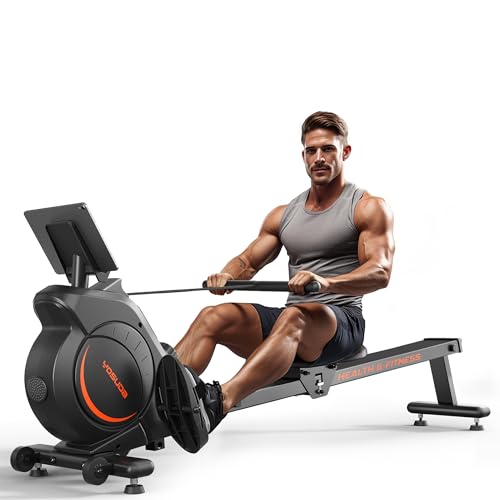
This magnetic rower is a space-conscious cardio and full-body trainer for apartment-friendly routines. Magnetic resistance keeps noise low while still offering enough load for steady-state rowing, intervals, and warmups before strength work. The long rail and higher weight capacity suit a wide range of body sizes. The basic LCD and tablet holder prioritize simple tracking and distraction-free training over app-heavy coaching.
Pros
- Quiet magnetic resistance suits shared spaces
- Smooth pull with consistent resistance
- Higher weight capacity fits more users
- Longer stroke range supports taller rowers
- Tablet holder helps pass longer sessions
Cons
- LCD metrics feel basic and not highly detailed
- Resistance may be light for advanced power training
In daily use, it feels best for consistent cardio, warmups, and recovery rows. The motion stays smooth with minimal vibration, so early mornings are realistic without disturbing others. Expect the monitor to cover essentials like time, strokes, and calories, but not deep performance analytics. Comfort is adequate for longer sessions, though a towel or pad can help on extended rows. Storage and moving are manageable for most homes.
Buy this if you want low-noise cardio that also trains back, legs, and core. It fits beginners through intermediate users who value smooth resistance and simple tracking over connected coaching. If your goal is fat loss, general conditioning, or supplementing strength training, it delivers strong utility per square foot. Skip it if you need very high resistance for sprint-power rowing or advanced metrics.
BalanceFrom 3-in-1 Foam Plyo Jump Box

This foam plyo box is a joint-friendlier way to add explosive training and step work at home. The rotating 3-in-1 design gives three height options without extra equipment, making it useful for beginners and progressing athletes. Foam construction reduces shin damage risk compared with wood, while the grippy surface improves confidence on landings. It works well for HIIT circuits, step-ups, box squats, and agility drills.
Pros
- Three heights in one box for easy progression
- Foam build reduces shin scrapes on misses
- Grippy surface improves landing confidence
- Lightweight for quick room-to-room setup
- Great for step-ups, jumps, and conditioning circuits
Cons
- Too light for very aggressive lateral jumps
- Foam can feel less stable than wood
For everyday training, it shines in circuits: step-ups, box jumps, elevated push-ups, and split-squat variations. Rotating to change height is fast, so you can progress within a single workout. The foam is forgiving when you clip an edge, which encourages practice without fear. On slick floors, placing it on a mat improves stability. It stores easily and is light enough to move between workouts without hassle.
Choose this if you want safer plyometrics, simple progression, and multi-use conditioning at home. It suits beginners learning jump mechanics, athletes adding volume without beating up joints, and anyone needing a sturdy step-up platform. Value is strongest when you’ll use multiple heights regularly. If you prioritize maximum rigidity for heavy box squats or very dynamic jumping, a heavier wooden box may fit better.
Frequently Asked Questions
What home gym equipment gives the most full-body training?
A power cage with cables plus a barbell and plates covers squats, presses, pulls, and accessories. Add a bench for angles. This setup scales for strength, hypertrophy, and general fitness.
Is a multifunction home gym machine better than a power rack?
Multigyms are simpler and space-efficient, but limit barbell work and progression options. Racks support heavier, more varied training and safer lifting with spotter arms, but need more space.
What should I buy first on a tight budget?
Start with a bench and adjustable resistance basics, then add a barbell and plates. If you want low-impact cardio, a rowing machine delivers high training value per square foot.
Our Recommendation
Best overall: Mikolo K6 Power Cage, especially with cable crossover, for the widest exercise range and long-term progression. Best budget: BalanceFrom 3-in-1 Foam Plyometric Jump Box for versatile conditioning and leg power. For guided resistance in small spaces, choose SincMill SCM-1148L or SCM-1148L&5003. For compact cardio and full-body endurance, the YOSUDA magnetic rower is the strongest add-on. Pair the bench, Olympic barbell, and 230 lb plates with the rack for a complete strength setup.